Talking to myself

I went with a crew from work to see I Am Legend on Friday night at Mann's Chinese Theater. I love the sound system there. Somewhere along the way they decided to solve that instead of offering the hearing impaired separate earphones they'd just kill two birds with one stone and crank the volume up to such ear-splitting levels that you walk out of the theater with your hair sticking back as if you'd been riding on the highway in a convertible with the top down. We even caught the new CGI-plant THX trailer (not up on the THX website yet), and there are few theaters better suited to demo a THX trailer in than the Chinese.


[I've never met anyone who enjoys THX, Dolby Digital, and DTS trailers more than I do. Of all of those, the THX trailers are my favorite. I whooped when it was over, embarrassing some of the people sitting with me. Another random thing that gives me an bizarrely disproportionate thrill: when Phil Collins goes all falsetto to sing "crying at the top of my lungs" in "In Too Deep" off of Invisible Touch; I have no idea why I just thought of that]


The "dark seekers" in I Am Legend did not achieve THX certification, if such a thing existed for CGI creatures. They looked like something out of a video game. It's a compliment to say that something in a video game looks like it came out of a movie, but the reverse is not so flattering. The last man on earth may not be alone, but it feels like he is because the bad guys chasing him are so poorly rendered.


Will Smith spends a lot of time wandering around Manhattan with his dog Sam, and, in the absence of other human beings, talks to everything he can: his dog, store mannequins, computers, and himself, in the grand tradition of Tom Hanks speaking to his volleyball in Cast Away. I don't think it's just a device to keep the movie interesting (though it does serve that convenient purpose).


In 2003, while on sabbatical, I wandered around South America for five weeks by myself. While in Torres del Paine, I went on a three and a half day trek by myself. I expected to see other people on the trail, but it was the middle of winter, not exactly peak tourist season. For three days, I didn't see a single person, not even way off in the distance. I didn't even see a trace of another person save for a piece of trash at one of the campsites.


In my childhood, I was fine going long periods without conversation, but after a day and a half on the trail I began talking to myself. I'd use the royal "we" in verbalizing my thoughts.


"Okay, what do we feel like eating?" I'd say, rummaging through my backpack for energy bars. "Do we want chocolate chip or peanut butter crunch?"


"Where the hell am I?" I'd say, unfolding my trail map and gazing up at the sky as if I had the ability to circumnavigate by the orientation of the sun.


Later, in the evening, as I lay shivering in my sleeping bag, I'd mutter, "Who the hell thought it was a good idea to trek through a Patagonian wilderness in the dead of winter?"


Obama in LA

Monday night, I saw Barack Obama speak in LA at the Gibson Ampitheatre. For a contribution to the campaign, I received a ticket to hear Obama speak. As I stood in line to get in, I scanned a mixed crowd ranging of all races, from teenagers in high school to senior citizens. Was this crowd more or less diverse than that for other candidates? Was Obama a great uniter? I had no frame of reference.


When I reached the security check, the guard took one look at my Nikon digital SLR and shook his head.


"That ain't going in," he said.


I bristled immediately.


Several days earlier, I had called the contact number listed for the event and described my camera and asked if it would be allowed into the event. I'd had to run back to the parking lot to leave my camera behind one time too many. The woman on the other end assured me that my camera would be welcome. I recounted this story to the guard, but he was not moved.


While he held me back from entering the event, one person after another walked past with their cameras. I asked why those cameras were allowed in while mine wasn't. He declined to elaborate, which infuriated me even more. The likely distinction was that my camera was an SLR while the ones being allowed through were compact, but I wanted to hear him say it so I could explain to him how ridiculous the policy was. But he remained impassive and mute, like a bouncer at some trendy nightclub.


I was directed to a table and forced to hand over my camera. A black cloud floated over my head as I walked into the facility.


The short-sighted aspects of this policy are numerous. An SLR generally takes better pictures than a compact camera, but compressed for the web, the distinctions in photo quality would be lost on the vast majority of users. Most compact cameras actually have longer zooms than the standard SLR lens. What was I going to do, sell high-quality pictures of Obama, one of the most photographed people in news today? Once inside the event, I saw some other folks who weren't press members who did manage to get there digital SLRs through security. I couldn't get the bad taste out of my mouth the rest of the night.


The first thing I would've done with any photos of Obama would be to post the best one here and sing his praises, but instead I've wasted ten minutes of my life ranting about the restrictive policy at this event. It's a lose-lose situation. In this day and age, allowing people to snap photos and share them across Facebook or Flickr or weblogs is a form of free publicity. I hope someone at the campaign does the right thing and corrects it for future events. This persecution of SLRs needs to end.


I grabbed a seat two rows up from the VIP section around the stage (yes, a seat good enough to have snapped some great photos...I'll stop now). After sitting for about an hour, a series of introductory speakers came out to sing Obama's praises and fire up the crowd. Nick Cannon of Drumline fame served as the host of the evening, and Kal "Kumar" Penn came out and spoke of his work campaigning for Obama in Iowa.


Having musical guests play at these types of events has always seemed forced to me. It's difficult to imagine any presidential candidate having enough time to listen to music or keep up with the music scene, and the political endorsements of all but a few musicians hold little value to me. The first musical guest was Ne-Yo. The speakers to either side of the stage were cranked up. I could literally feel the sound waves hitting me in the chest. The other musical guest was The Goo Goo Dolls, an odd choice to me considering their last big hit was in...umm...


Sitting in front of me at the event was a familiar face, but not familiar enough for me to know by name. I knew he was an actor, but I couldn't place him. He left his seat early in the event, and the next time I saw him was on stage, as one of the speakers. It was James Whitmore.


There were plenty of movie stars in the crowd (the online web page for the event listed people like Scarlett Johansson, Jessica Biel, and Olivia Wilde; it's good to know Obama has locked up the Hollywood hottie vote). But there was no doubt who the biggest star in the room was on this night.


Throughout the night and especially during Obama's speech, speakers hammered on several key message of their campaign.


  • Obama did not vote for the Iraq war, and Republicans will not be able to use that against him (the contrast to Clinton was unspoken, but only because it was so clear that she was the target).

  • The American people need someone to tell them what they need to hear, not what they want to hear. This is part of Obama's conscious strategy to inform the electorate that he plans to run a non-traditional campaign, one in which he's not afraid to speak honestly about what the tradeoffs are. If certain policies require raising taxes, then he's going to tell it like it is. As a realist I find this refreshing, though I'm not convinced it's the optimal campaign strategy. I hope his instincts are right.

  • His is a campaign that embraces all people, of all races and sexual orientations and political affiliations. Over and over, he spoke of the need to dispense with red state blue state model of the U.S.

  • He intends to be the greenest President in history, and he plans to generate jobs through his efforts to aid the environment.

  • Universal health care.

  • Raise minimum wage, bridge the gap between the haves and the have-nots.

  • He plans to restore the U.S. standing in the international community. He said he awaited the day when he can stand before the United Nations and tell the world, "We're back."


He displayed some humor during the evening, first in talking about his disappointment in finding out he was related to Dick Cheney, the second about the Clinton campaign's investigation into his Kindergarten papers. Of the latter, he noted, "We'll be releasing those papers on Monday. I tugged on a girl's ponytail once. And liked it."

It's dangerous to judge too much about a candidate's policies and qualifications for office at a rehearsed event like this. But whether you mean to or not, you assess a person's personality and character when you meet them in person, the same way you measure a person from the first moment you meet them in a job interview. Their body language, their words, their voice, their posture--all these feed into your perception of the person.

On that front, Obama is the most compelling candidate, either Democrat or Republican, in the upcoming election. He has a certain charisma that's difficult to teach. Clinton is polished and experienced and competent, but she lacks his inherent magnetism.


The other thing that struck me was how easy it was to garner huge support in this election just by promising not to be Dubya. Who thought that eliciting enthusiastic screams for a crowd could be as simple as saying, "I promise not to torture people in Guantanamo!"


Connor


I visited Connor in DC the weekend after Thanksgiving. He is a mellow kid whose smiles are fleeting, but thanks to high speed continuous frame rate shooting modes on my digital SLR, I was able to capture a few or his elusive expressions of happiness.


By the way, you do not want to get into a staring contest with Connor, he will wait you out until your eyes are watering something fierce. He has an amazing poker face, and I expect we'll be sending him to Uncle James at an early age to begin his training.


Technorati Tags: ,


Bad WOM

Heard from a couple folks who saw The Golden Compass Friday...extrapolate from just those few data points and the prognostication for this expensive fantasy epic is poor, despite the studio spending many years sanitizing the movie of the book's more overt religious content in an effort to appeal to the masses. Will Smith and I Am Legend are going to eat this movie for breakfast next weekend.


The Obama argument

Andrew Sullivan makes the case for Barack Obama in The Atlantic Monthly. A good summary of why he's my choice, also.


Glassbooth.org asks you a series of questions and then matches you to the Presidential candidate most representative of your concerns and views. I'm no expert on politics, but I do have a few thoughts:


  • Most of the Democratic candidates have fairly similar policy proposals. So electability versus the putative Republican candidate matters more than any one particular policy stance.

  • Instead of trying to elect the candidate who will do the greatest good, it's more important to avoid electing the candidate who will do the greatest harm. I think of government as more analogous to baseball, where one superstar has less impact, than basketball, where you can build a competitive team around one great player.

  • I don't believe the old adage about idealistic young Democrats becoming wealthy old Republicans holds as strongly as one suspects. More likely to me that your party affiliation is set in your first couple of elections and held there by inertia and some desire for appearing consistent in your beliefs. I think Obama is best positioned to continue Democratic strength among the younger demographic, and in doing so, solidify the Democratic vote for a couple elections.


Again, I have no evidence to support these points. They are just my hypotheses.


How to turn off Beacon in Facebook

Facebook has been beaten up a lot this past week about its Beacon product, and rightly so. I heard the company had backed off on this feature, but when i checked my account last Thursday I had still been opted into this feature. Here's how to turn it off:


  1. Log into Facebook

  2. Click on "privacy" in the upper right (the link should read "lack of privacy," no?)

  3. Click on "External Websites"

  4. Check the box that says "Don't allow any websites to send stories to my profile"

  5. Click the Save button


Lifehacker Australia has a note about how to block Facebook's Beacon from tracking your offsite activity even if you've turned off Beacon notifications in privacy settings.


I don't think this controversy itself will cause Facebook to jump the shark as others have prognosticated, but it does solidify my impression of the brand of Facebook as ethically questionable, a site you have to keep a close eye on. It's the same discomfort you experience when you register at a site and it opts you in by default to receive e-mails from partners, instead of leaving that box unchecked. Facebook has always been aggressive in opting people into features that reveal a lot of what that person is doing (a lot of the site's appeal, beyond its clean design, is the voyeuristic nature of the news feed), but this Beacon affair implies how far they're willing to take things as a default, that ad revenue comes above user privacy. Facebook needs an ombudsman.


This week Hulu was temporarily dinged by Kevin Maney for sharing his Hulu surfing activity with Facebook, something we'd never never do. This is another of the insidious side effects of Beacon, the negative halo it casts on other websites. For a few days, when I heard that one's Amazon purchases would be displayed on Facebook, I thought perhaps Amazon had participated in Beacon. But having worked there, I just couldn't believe that Amazon would have changed so much. And it turned out they hadn't: Amazon does not participate in Facebook's Beacon program. But plenty of people implied that they did. Kevin Maney and other sites can issue retractions, but plenty of readers will see just the first negative post and never come back to read the retraction.


Facebook is still useful for monitoring what some of my friends are up to, especially younger ones. But I've past my point of peak usage. Facebook is the gossipy friend who shares all your personal details the moment you confide in it, and I'm cutting it back to "need-to-know" basis.


The power of process

Atul Gawande writes in the New Yorker about the impact of the checklist in the world of medicine. Process is helpful in complex tasks. Having worked at more than one startup now, I've seen this evolution before. The early days, when a company is understaffed, so many massive projects depend on the willpower and energy of a select few. One or two strong and talented personalities drives work to completion. There are so many places something can go wrong or be dropped, but when projects are pulled off, heroes are made.


Over time, though, the scalable route is to hire more specialists and systematize workflows. There are fewer heroes, work becomes more routine, and those who thrive on flying without a checklist move on in chase of the next adrenaline rush.


Two articles from the Sunday NYTimes

AIDS has peaked. It's not cured, it still afflicts millions of people worldwide, but the number of new infections seems to have peaked in 1998.


***


The joys (or lack thereof) of a green Christmas.


...the 2.6 billion holiday cards sold each year in the United States could fill a landfill the size of a football field 10 stories high, or that those conventional lights on the Christmas tree contribute up to nine times as much greenhouse-gas emissions as the leaner-burning L.E.D. models; or that some Christmas-tree growers use as many as 40 different pesticides, as well as chemical colorants, on their crops.

I found this amusing:


Ms. Perla said she read her children her book — in which Santa’s home at the North Pole is melted by global warming — before bed...

Some easy ways to go green this holiday season, though they might not seem as festive as usual:


  • Don't mail holiday cards and photos. Use e-mail and digital photos instead. With the money you save on cards and postage, purchase a carbon offset and divide it among all your usual card recipients, making a note of it in your e-mail.

  • Use L.E.D. Christmas tree lights, or, if you're willing to do without, just use ornaments.

  • Instead of a real tree, use a fake one. Miss the real tree smell? Buy some pine tree scents. Or make a popcorn strand which will give your living room a pleasant if different scent for the holidays.

  • Instead of cranking up your heater, wear a sweater (something I heard from my mom many a time in my HVAC-deprived youth; she was way ahead of this green movement).

  • Save paper; don't giftwrap or use lots of packing tissue which will just be tossed after being torn up. Instead, use toilet paper which can be re-used afterwards in the bathroom (your lactose-intolerant grandfather will appreciate it after he has one Christmas cookie too many).


One of my coworkers has suggested on more than one occasion that the perfect carbon offset is to kill someone roughly the same age as you who has a similar carbon footprint. Somehow I don't think that passes the "peace on earth and goodwill towards men" holiday theme, but maybe file that away for the new year, when you're making resolutions.


Japanese for awesome

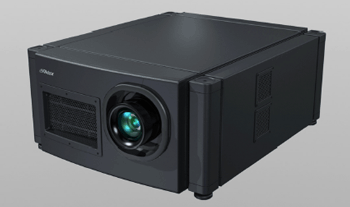
All this Japanese text? What it means is this: sweet 4K projector, the Victor DLA-SH4K, with 4096x2400 pixels of resolution, 10,000:1 contrast, and 3,500 lumen brightness. All for the measly sum of 90K Euros.


Extrapolate price reductions out far enough and someday we'll all have these in our living rooms. Most home videos will be shot on 4K and have incredible resolution. Unfortunately they'll still all be as boring as hell.


Rock Band...oh dear

I got my copy of Rock Band for the PS3 on Wednesday, and I had just a few hours to bang on it before packing for my Thanksgiving trip.


The game, in theory, is fantastic. It comes with a guitar, a drum set, and a microphone, and you can play one of the four (the guitar can be used to play lead guitar or bass). I started with the guitar, and for about fifteen minutes, all was good. And then my guitar just stopped working. It seemed as if the keypad was frozen on the up direction. I tried all sorts of things to get it to work again, to no avail. I jumped online immediately and ordered a replacement guitar via the warranty site.


Now come reports that lots of people are running into issues with their Rock Band hardware. The "one of my instruments is broken" thread at the Rock Band tech support forum is long and growing. The problem most people are experiencing is problems with the down strum on the guitar. I didn't even get to play long enough to encounter that issue.


Now, there's a chance that this is just selection bias, that reading a thread specifically opened for hardware problems will only scare you. But to see so many threads on the web about hardware issues is really suspicious.


What could have been a triumphant launch could quickly turn into a disaster for Harmonix. Let's hope there's a recall on the horizon, because otherwise there could be a revolt. I'd love to be able to recommend Rock Band; the drum set still works for me, ditto the microphone, and the music selection is great. It's just a great concept for a game. But the shockingly poor QA on the guitar means I can't recommend the game for anyone until the hardware issues are addressed.


Harmonix needs to address this issue. They can't sweep something like this under the rug in the age of the Internet, or a promising franchise will be doomed from the start. Another question: all these glowing reviews I read of Rock Band, yet not a single reviewer noticed this issue with their review copies?


Beowulf in 3D

Another one of the BAFTA screenings Hazel let me tag along for was an early screening of Beowulf in 3D. I was less interested in the movie itself than trying out the 3-D experience. I've always been excited by the possibility of seeing movies in true 3-D, but all the 3-D movies I've seen to date have been a disappointment. The last movie I saw in 3-D was Superman Returns in IMAX 3-D and I preferred the non 3-D version. There were many moments in the 3-D version when I couldn't tell what was happening. In scenes of high motion, the picture seemed blurry.


Beowulf uses Real D's 3-D technology. Instead of those old corny red and blue 3-D glasses, Real D's glasses hold circular polarized lenses.


So how does it look?


A lot better than the old 3-D technology. The images seem better aligned, and the 3-D effect is more consistent from start to finish. There are still occasional moments of high motion, when things fly quickly from foreground to background or vice versa, when it's difficult to lock your eyes into the proper plane of depth, but not many. The new 3-D tech paired with Robert Zemeckis's motion capture technology produced something that looked like a really expensive, immersive video game cut scene.


The problem with digital motion capture animation, though, remains a certain dead or frozen quality to human faces. It's improving, but still not quite there. It's as if every character had one Botox injection too many. The more cartoon-like faces of characters in traditional animation or in a movie like Ratatouille are still more expressive.


As for the story, I doubt many high school English teachers will be showing it in class as a supplement to reading the old English poem, but it does elicit a chuckle or two, whether intentional or not. If you see it, see it in 3-D, as another milestone on the 3-D development roadmap. At our screening we were allowed to take the RealD glasses home, and with the addition of eyebrows, a rubber nose, and and a moustache they'll make a stylish and technologically advanced pair of Groucho Marx glasses for the next such 3-D screening.


Last weekend

If you ever want to experience what it would be like if there was a run on goods because of impending disaster, come to LA and go shopping at Costco or IKEA on weekend. I was with my roommates at IKEA this past weekend and a woman riding in one of those motorized chairs drove into the back of my right foot in an effort to get into a cashier's line. I hobbled around for a day with what felt like a contusion on my Achilles tendon.


***


Why can't DirecTV put another set of satellites in the North? I moved to an apartment on the north side of the building, and now I'm relegated to standard def because our complex signed a deal with Clear Bay Communications, and they're too cheap to rewire the building for high definition for DirecTV. My only choice is standard def DirecTV. In my previous apartment I could just get a view of the southwest sky from the balcony, on which I mounted a high-def DirecTV satellite. Now I can't see the southwest sky, but I can sure see the clouds...no, wait, those aren't clouds, those are the huge pixels of my crappy television image through standard def.


DirecTV has a great product if you can get it, but the "if you can get it" part of that is more of a catch than it should be.


***


I was unpacking more boxes this weekend, and I found my passport and an iPod nano that I thought I lost two years ago. I should unpack more often.


***


James Surowiecki on the writer's strike. Both sides believe strongly in their positions. The studios aren't making much off the web yet (nowhere near what they make in syndication or DVD sales), so they don't want to strike any long-term deals now. The writers did not get their fair share on DVDs from their last agreement, and they don't want to get burned again if the internet takes off as quickly as DVDs did.


Given all this, the two sides should strike a short-term rev share % agreement and go back to the negotiating table after it expires. The money online really isn't significant yet relative to DVD and syndication, and a more just % deal will buy some time for the online market to mature.


But the smarter long-term view for writers and directors and producers and actors, in my opinion, is to look to the Internet as a way to bypass the network and studio system altogether and get more fair value for their work. It won't happen right away, as the theatrical and DVD markets are still quite lucrative marketing and distribution systems while the Internet is still in its infancy in this space. But it may happen sooner than people realize.


There's an entire new generation coming up that's used to watching programming on a computer, or getting content from the computer to their TV. Broadband penetration and web speeds will continue to increase to the point where getting high-def content through the Internet will be just as fast as getting it from a satellite or cable. At that point, for many creative types the equation will shift so that it's more efficient for them to go direct to consumer rather than through the studio system. It won't be worthwhile for them to cede so much of the profit to a middleman who probably can't market their product efficiently anyhow.


Blockbuster mass-market movies may still benefit from launching on thousands of screens opening weekend, but most other programming will benefit more from efficient Internet-driven targeting. Maybe no such mechanism exists today online, but it's not difficult to imagine a company like Amazon is for books arising on the web to help people find the film and television programming they'll love.


The last foothold for studios in this distant future may be the theatrical distribution space. It's not easy to replicate a network of thousands of movie theaters nationwide. That's just not a lucrative business. But even as much as I love the look of film, the advent of digital technology will lower the cost of distribution to the point where building a network of theaters that only downloads massive digital files of movies will be feasible, avoiding the massive cost of generating all those prints. Cameras like the Red One will enable indie filmmakers to shoot films that can be projected on a massive theater screen and look fantastic at a much lower cost than shooting 35mm film. These files can be edited on a desktop workstation, and the digital output can be distributed to theaters with digital projectors.


The other things artists have traditionally depended on studios for is financing. But even there, times have changed. I took a class at UCLA last year called Indie Film Financing, and every week a different type of financier came in to talk about some film project they'd funded. It's not just studios anymore. We heard from old-fashioned banks, private equity, ultra-wealthy individuals, and on and on.


We will get back to a world where the scarcity is not in theater screens or financing but something much harder to solve, and that's true creative talent.


***


Speaking of the future of content distribution, the stats from the Radiohead experiment in direct distribution of their album "In Rainbows" are fascinating. The average price paid among people who paid for the download was $6.00. Given that over 60% of customers chose not to pay at all for the download, the average price paid worldwide was $2.26 per album.


Sounds low? It's still more than Radiohead would have made per album if they'd gone through a studio. I think they could have easily gotten sales if they'd chosen to sell their album at, say $4.00 a pop, instead of letting consumers name their own price. But this turned out to be a much more interesting, and I think, successful experiment.


***


Last Saturday I went downtown and caught the Takashi Murakami exhibit downtown at the Geffen Contemporary at the MOCA. I love his massive prints and his appropriation of pop and high culture. His works seem to distill so many elements of Japanese culture.


I had hoped to buy a print there, but the museum only carried limited editions of 300 of a few of his prints, and they had all sold out already. I had to settle for a t-shirt.


Murakami collaborated with Marc Jacobs, artistic director for Louis Vuitton, on a series of handbags. On display at the museum was a luggage chest with about a dozen or so compartments inside, each holding a Louis Vuitton handbag. Out of curiosity, one of my friends asked how much the chest was. It turns out you can take that chest and all the handbags inside it home for the meager sum of $500,000.


Not for sale were these two NSFW scultpures.


Also playing at the exhibit was Murakami's music video for Kanye West's song "Good Morning" off of Graduation. I guess it hasn't released to the world yet as the only copy I can find online is at YouTube, some bootleg from the Murakami exhibit. Not the best way to enjoy it.